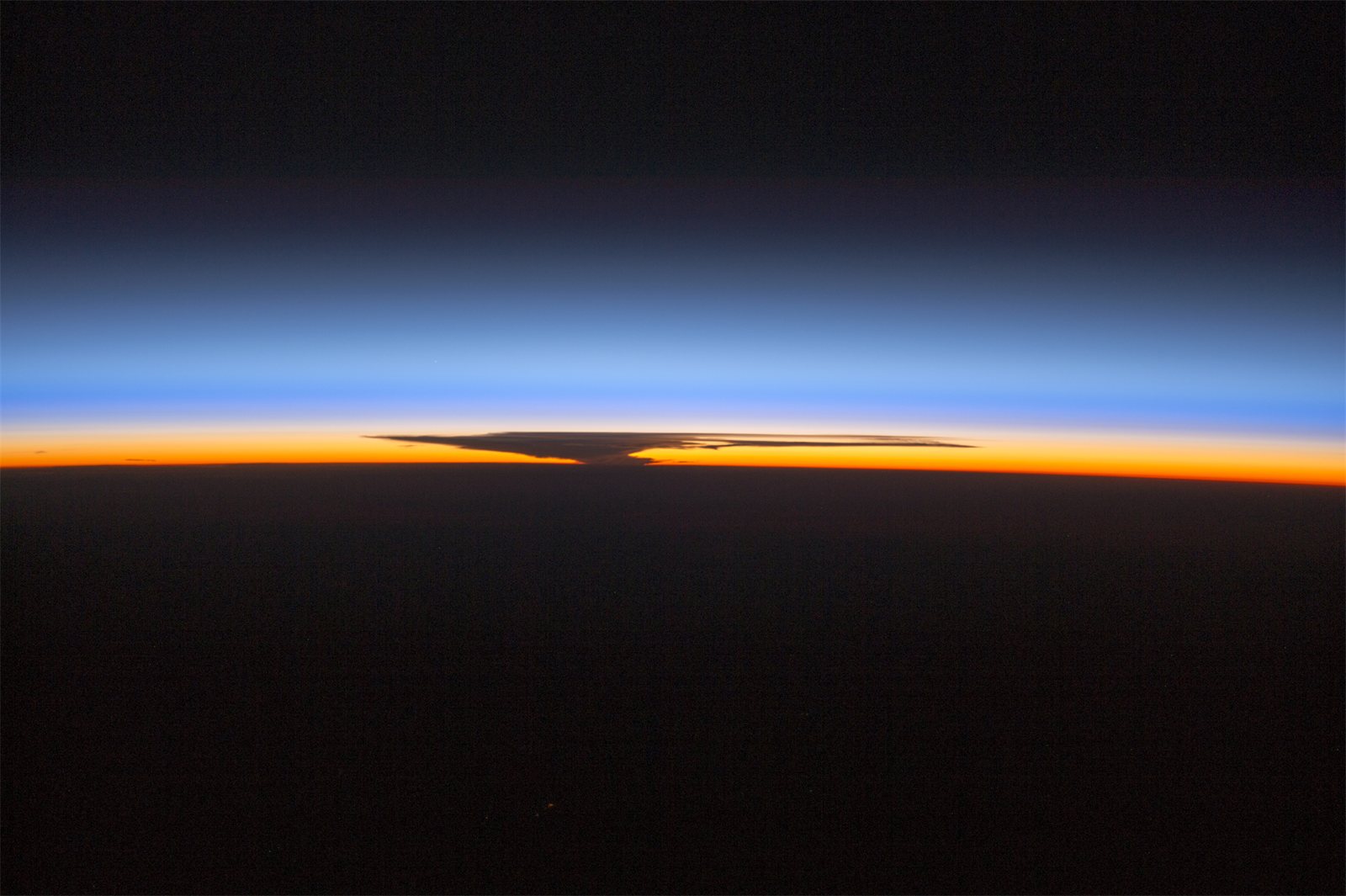
In the Qur'an, the words used for describing the universe are quite remarkable. The Arabic word that is translated as "to wrap" in the above verse is "takwir".
«He has created the Heavens and the Earth for Truth. He wraps the night up in the day, and wraps the day up in the night.»
In the Qur'an, the words used for describing the universe are quite remarkable. The Arabic word that is translated as "to wrap" in the above verse is "takwir". In English, it means "to make one thing lap over another, folded up as a garment that is laid away". (For instance, in Arabic dictionaries this word is used for the action of wrapping one thing around another, in the way that a turban is put on.)
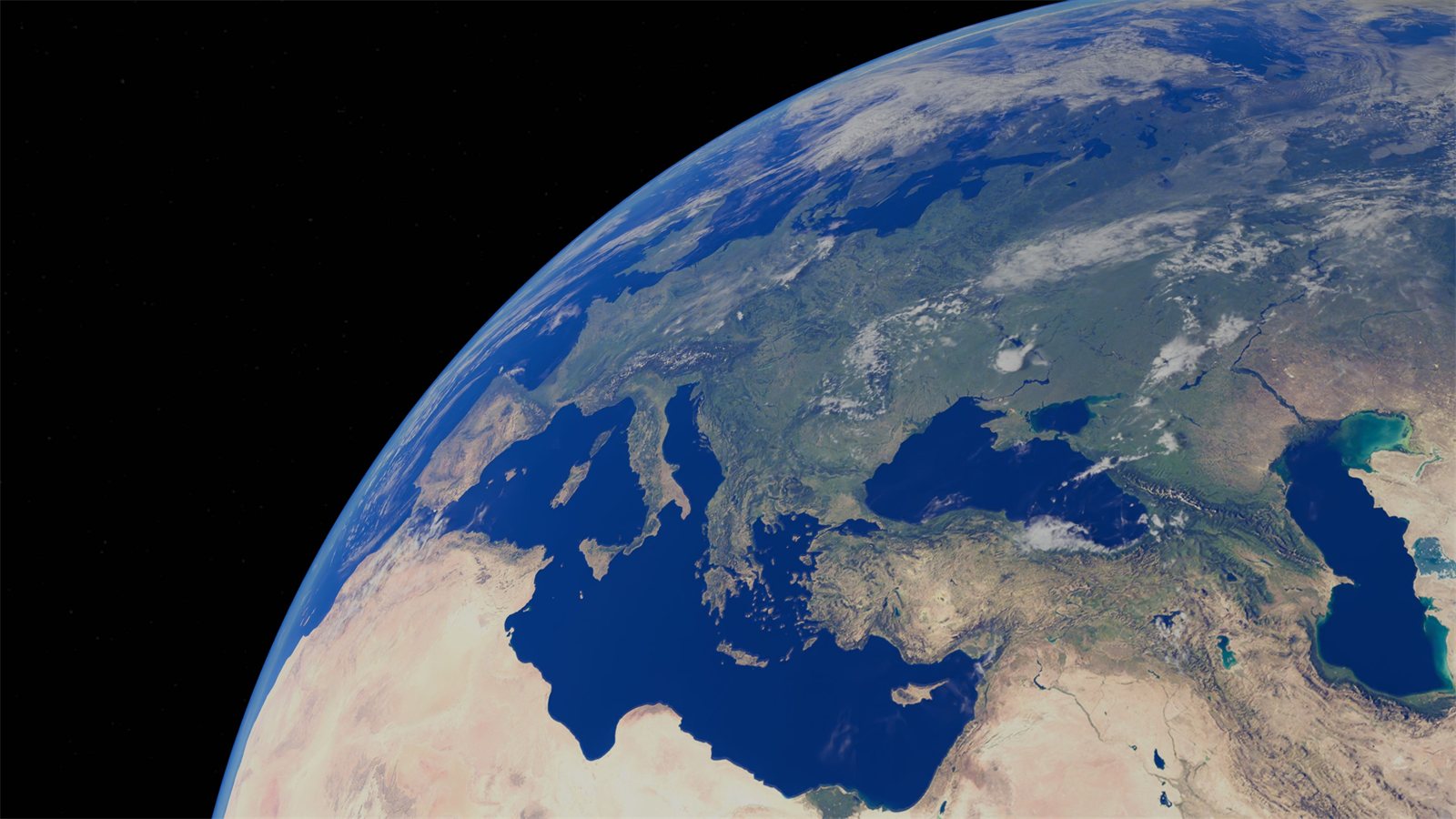
The information given in the verse about the day and the night wrapping each other up includes accurate information about the shape of the world. This can be true only if the earth is round. This means that in the Qur'an, which was revealed in the 7th century, the roundness of the world was hinted at.
It should be remembered, however, that the understanding of astronomy of the time perceived the world differently. It was then thought that the world was a flat plane and all scientific calculations and explanations were based on this belief. The verses of the Qur'an, however, include information that we have learned only in the past century. Since the Qur'an is God's word, the most correct words were used in it when it comes to describing the universe.
The Earth's Direction of Rotation
The above verse emphasises that the Earth not only rotates but that it also has a direction of rotation.
«You will see the mountains and reckon them to be solid; but they go past like clouds -the handiwork of Allah Who gives to everything its solidity. He is aware of what you do.»
The above verse emphasises that the Earth not only rotates but that it also has a direction of rotation. The direction of movement of the main cloud masses at 3,500-4,000 metres (11,500-13,000 feet)high is always from West to East. That is why it is generally the state of the weather in the West which is looked at in meteorological forecasts.67
The main reason why cloud masses are pulled from West to East is the direction in which the Earth rotates. As we now know, our Earth spins from West to East. This scientific fact, only recently established by science, was revealed in the Qur'an 1,400 years ago, at a time when the Earth was believed to be flat, and to be resting on the back of an elephant.
The Earth's Geoid Shape
In the above verse, the word " dahaa " is used in the original Arabic. It, translated as "smoothed out," comes from the word " dahaw ," meaning "to spread." Although the word " dahaw " also means to cover or to set out, the…
In the above verse, the word " dahaa " is used in the original Arabic. It, translated as "smoothed out," comes from the word " dahaw ," meaning "to spread." Although the word " dahaw " also means to cover or to set out, the meaning of the verb is more than just a prosaic setting out, since it describes setting out in a circle.
The concept of roundness is also present in other words derived from " dahaw ." For example, the word " dahaw " also refers to children dropping a ball into a hole in the ground, games involving throwing stones into holes and games played with walnuts. Words derived from that root are also used for an ostrich making a nest, cleaning stones from where it is about to lie down, the place where it lays its eggs and the egg itself.
Indeed, the Earth is round, in a manner reminiscent of an egg. The slightly flattened spherical shape of the Earth is known as geoid. From that point of view, the use of the word " dahaa " contains important information about the shape that Allah has given to the Earth. For hundreds of years, people imagined the Earth to be completely flat and only learned the truth thanks to technology. Yet, this fact was revealed in the Qur'an fourteen centuries ago.
The Layers of the Earth
One item of information about the Earth given in the Qur'an is its similarity to the seven-layered sky:
One item of information about the Earth given in the Qur'an is its similarity to the seven-layered sky:
«It is Allah Who created the seven heavens and of the Earth the same number, the command descending down through all of them, so that you might know that Allah has power over all things and that Allah encompasses all things in His knowledge.»
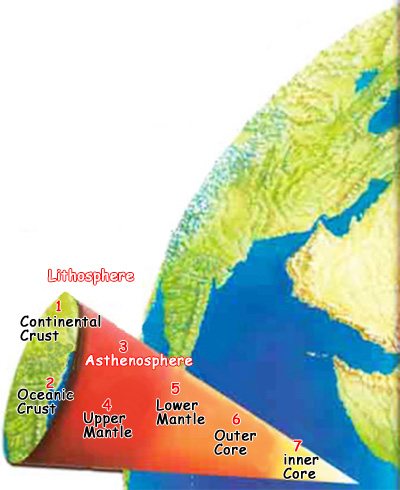
The information in the above verse is confirmed in scientific sources, wherein it is explained that the Earth consists of seven strata. These, as scientists have identified, are:
1st layer: Lithosphere (water)
2nd layer: Lithosphere (land)
3rd layer: Asthenosphere 4th layer: Upper Mantle 5th layer: Inner Mantle 6th layer: Outer Core 7th layer: Inner Core The word lithosphere is derived from the Greek word lithos, meaning stone, which is a hard stratum forming the Earth's top layer. It is quite thin in comparison to the other strata. The lithosphere under the oceans is still thinner, and is a region with volcanic activity. Its average thickness is 80 km (49.7 miles). It is colder and harder than the other strata, and therefore, forms the Earth's shell.
Below the lithosphere is the stratum known as the asthenosphere, from the Greek word for "weak," asthenes. This layer is thinner than the lithosphere and shifts. It was formed of hot, semi-solid substances capable of melting when exposed to high temperatures and pressure over geological time. It is thought that the hard lithosphere floats or moves over the slowly moving asthenosphere.68
Under these layers is a high-temperature layer some 2,900 km (1,800 miles) thick, made up of semi-solid rock known as the mantle. This contains more iron, magnesium and calcium than the crust, and is also hotter and denser, because temperature and density in the Earth increase with depth.
At the centre of the Earth is the core, approximately twice as dense as the mantle. The reason for that density is that it contains a higher proportion of metals (iron-nickel alloy) than rock. The Earth's core consists of two parts. One is the 2,200 km (1,370 miles) thick liquid outer core, the other a 1,250 km (777 miles)thick solid inner core. The liquid outer core provides the Earth's magnetic field as the planet rotates.
The truth of this similarity between the sky and the layers of the Earth, only identified by 20th century technology, is without doubt another of the Qur'an's scientific miracles.
The Earth Disgorges Its Charges
The word " zilzaal " in Arabic means earthquake, or tremors, and the word " athqaalahaa " means "charges, heavy burdens." When one considers the above verses in the light of the first meaning, it can be seen that reference is…
«When the Earth is convulsed with its quaking and the Earth then disgorges its charges and man asks, "What is wrong with it?", on that day it will impart all its news.»
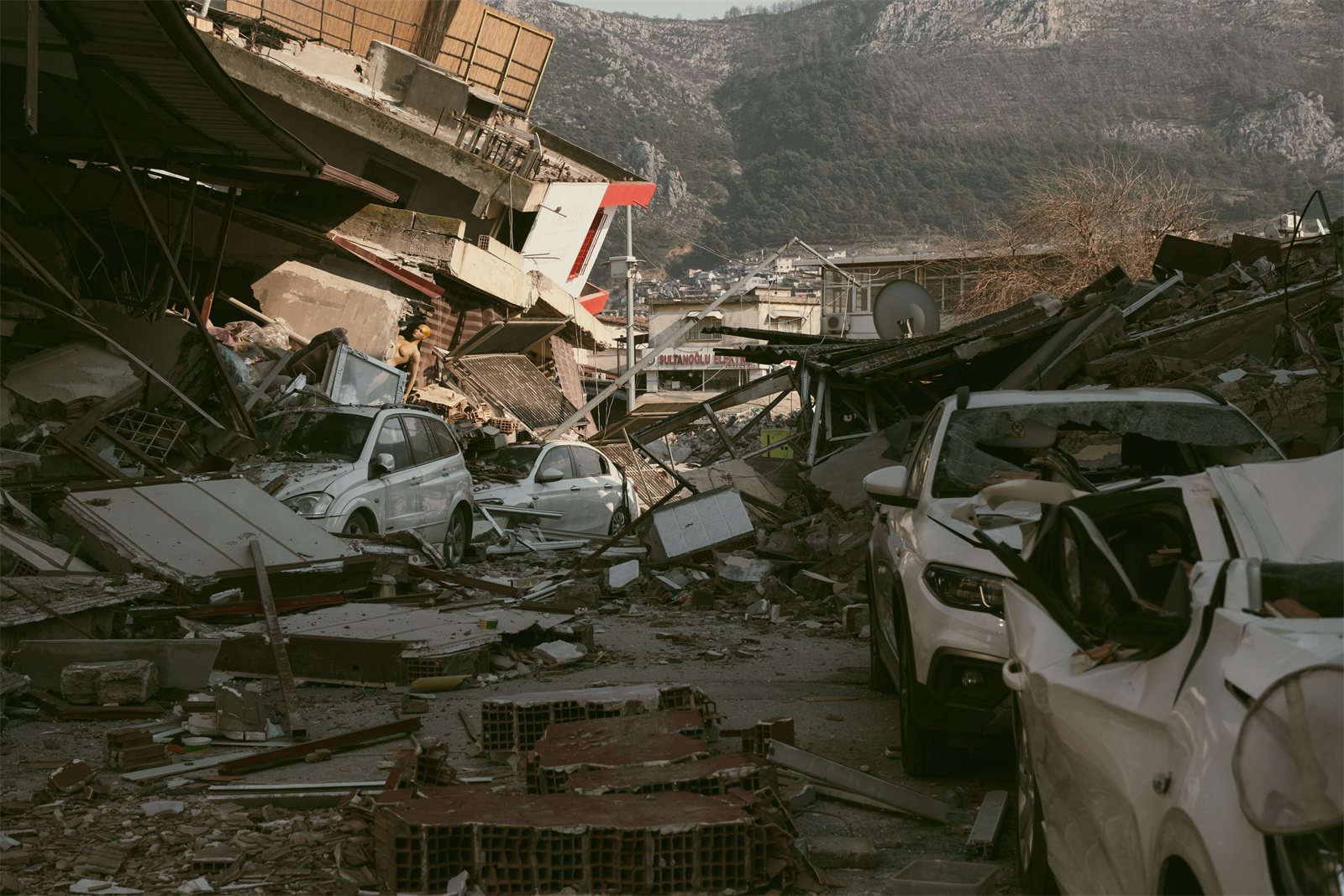
The word " zilzaal " in Arabic means earthquake, or tremors, and the word " athqaalahaa " means "charges, heavy burdens." When one considers the above verses in the light of the first meaning, it can be seen that reference is being made to an important scientific fact about earthquakes.
Surat az-Zilzal 2 mentions the Earth disgorging its charges. Indeed, as a result of research in recent years, it has been realised that there are heavy metals at the centre of the Earth, and that these appear as a result of movements on the Earth's surface. According to geologists' calculations, as the Earth cooled, heavy and dense substances sank to its centre, while lighter ones rose to the surface. For that reason, the Earth's crust consists of the least heaviest substances (basalt and granite rocks), while heavy metals (nickel and iron) are found in the core. As a result, the subsurface, which consists of molten metals, is made of a material that is much heavier and denser than the surface.
During earthquakes, the heavy substances below the surface have an opportunity to rise, and the Earth thus disgorges its charges, as revealed in the Qur'an. Moreover, those regions where metal reserves are most concentrated are also those with the greatest volcanic activity. These scientific findings, which emerged only recently, and as a result of wide-ranging research, are just some of the scientific facts indicated by Allah in the Qur'an.
Mountains — the pegs of the earth
The Quran says that mountains were made as “pegs” and that they keep the earth from shaking. Modern geology has discovered that mountains have roots reaching deep into the earth.
move the lens with your pointer or finger
10–15×: root depth compared to height
≈ 125 km: Everest’s underground root
1–5 cm/yr: speed of continental drift
The Qur'an draws attention to a very important geological function of mountains.
«We placed firmly embedded mountains on the earth, so it would not move under them…»
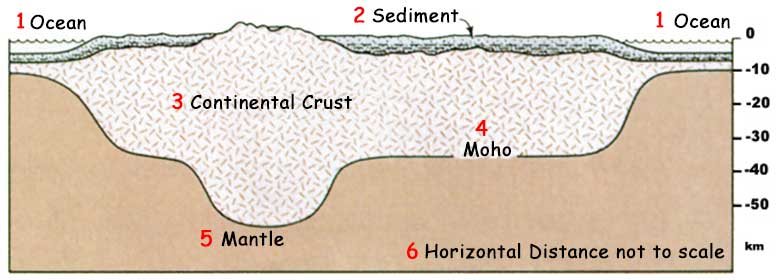
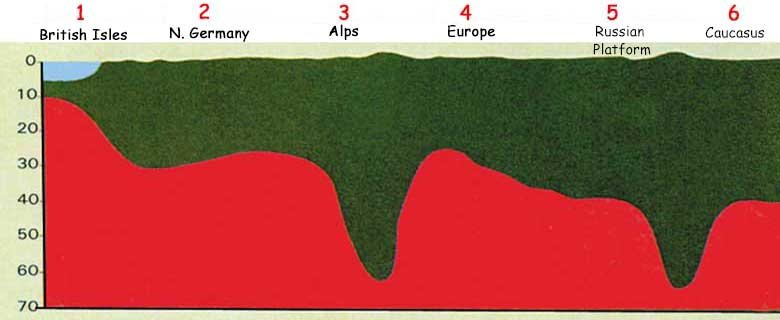
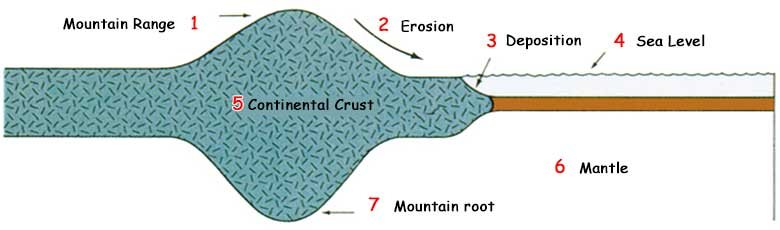
Ocean 2. Sediment 3. Continental Crust 4. Moho 5. Mantle 6. Horizontal distance not to scale Mountains have roots deep under the surface of the ground. (Earth, Press and Siever, p. 413)1. British Isles 2. N. Germany 3. Alps 4. Europe 5. Russian Platform 6. Caucasus Schematic section. Mountains, like pegs, have deep roots embedded in the ground. (Anatomy of the Earth, Cailleux, p.220)1. Mountain Range 2. Erosion 3. Deposition 4. Sea Level 5. Continental Crust 6. Mantle 7. Mountain Root Another illustration shows how mountains are peglike in shape, due to their deep roots. (Earth Science, Tarbuck and Lutgens, p.158)
As we have noticed, it is stated in the verse that mountains have the function of preventing shocks in the Earth.
This fact was not known by anyone at the time the Qur'an was revealed. It was in fact brought to light only recently as a result of the findings of modern geology.
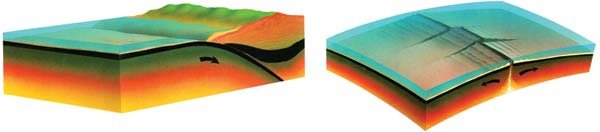
According to these findings, mountains emerge as a result of the movements and collisions of massive plates forming the Earth's crust. When two plates collide, the stronger one slides under the other, the one on the top bends and forms heights and mountains. The layer beneath proceeds under the ground and makes a deep extension downward. That means that mountains have a portion stretching downwards, as large as their visible parts on the Earth.
In a scientific text, the structure of mountains is described as follows:
Where continents are thicker, as in mountain ranges, the crust sinks deeper into the mantle.69
In a verse, this role of the mountains is pointed out by a comparison with "pegs":
«Have We not made the earth as a bed and the mountains its pegs?»
With extensions that mountains extend out towards under the ground as well as over the ground, they clench different plates of the earth together like a peg. The Earth's crust consists of plates that are in constant motion. This clenching property of mountains prevents shocks to a great extent, by fixing the earth's crust, which has a very movable structure.
Mountains, in other words, clench the plates in the Earth's crust together by extending above and beneath the Earth's surface at the conjunction points of these plates. In this way, they fix the Earth's crust, and prevent it from drifting over the magma stratum or among its plates. Briefly, we may liken mountains to nails that keep pieces of wood together.
This fixing function of the mountains is described in scientific literature by the term "isostasy". Isostasy means the following:
Isostasy: general equilibrium in the Earth's crust maintained by a yielding flow of rock material beneath the surface under gravitational stress.70
This vital role of mountains, that was discovered by modern geology and seismic research, was revealed in the Qur'an centuries ago as an example of the supreme wisdom in God's creation.
«We placed firmly embedded mountains on the earth, so it would not move under them...»
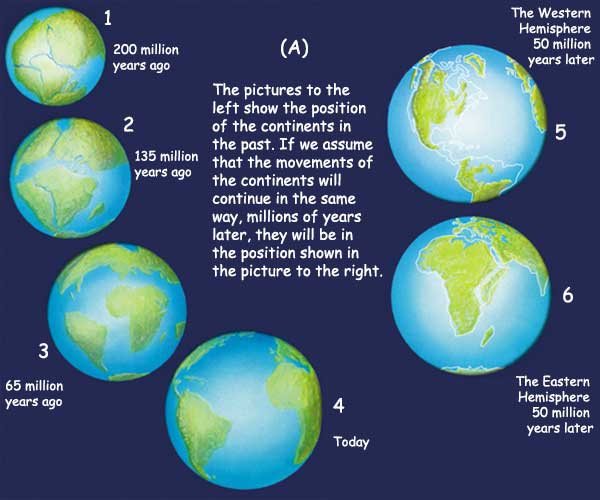
1. 200 million years ago 2. 135 million years ago 3. 65 million years ago 4. Today 5. The Western Hemisphere 50 million years later 6. The Eastern Hemisphere 50 million years later The pictures to the left show the position of the continents in the past. If we assume that the movements of the continents will continue in the same way, millions of years later, they will be in the position shown in the picture
The Movements of the Continents
This motion of the mountains is caused by the movement of the Earth's crust that they are located on. The Earth's crust 'floats' over the mantle layer, which is denser. It was at the beginning of the 20th century when, for the first time in history, a German scientist by the name of Alfred Wegener proposed that the continents of the earth had been attached together when it first formed, but then drifted in different directions, and thus separated as they moved away from each other.
Geologists understood that Wegener was right only in the 1980s, 50 years after his death. As Wegener pointed out in an article published in 1915, the land masses on the earth were joined together about 500 million years ago. As Wegener pointed out in a 1915 article, the land masses of the earth were joined together some 500 million years ago, and this large mass, called Pangaea, was located in the South Pole.
Approximately 180 million years ago, Pangaea divided into two parts, which drifted in different directions. One of these giant continents was Gondwana, which included Africa, Australia, Antarctica and India. The second one was Laurasia, which included Europe, North America and Asia, except for India. Over the next 150 million years following this separation, Gondwana and Laurasia divided into smaller parts.
These continents that emerged after the split of Pangaea have been constantly moving on the Earth's surface at several centimetres per year, in the meantime changing the sea and land ratios of the Earth.
Discovered as a result of the geological research carried out at the beginning of the 20th century, this movement of the Earth's crust is explained by scientists as follows:
The crust and the uppermost part of the mantle, with a thickness of about 100 kms., are divided into segments called plates. There are six major plates, and several small ones. According to the theory called plate tectonics, these plates move about on Earth, carrying continents and ocean floor with them. Continental motion has been measured at from 1-5 cm per year. As the plates continue to move about, this will produce a slow change in Earth's geography. Each year, for instance, the Atlantic Ocean becomes slightly wider.71
There is a very important point to be stated here: God has referred to the motion of mountains as a drifting action in the verse. Today, modern scientists also use the term "Continental Drift" for this motion.72
Unquestionably, it is one of the miracles of the Qur'an that this scientific fact, which has recently been discovered by science, was announced in the Qur'an.
Different Points in the Rising and Setting of the Sun
As can be discerned, the words east and west are used in the plural sense in the above verses. For instance, the word " mashaariq ," used in the first verse for "east," and the word " maghaarib " used for "west," are in plural…
«No! I swear by the Lord of the easts and wests that We have the power.»
As can be discerned, the words east and west are used in the plural sense in the above verses. For instance, the word " mashaariq ," used in the first verse for "east," and the word " maghaarib " used for "west," are in plural form, indicating that there are two of each. The words " mashriqayn " and " maghribayn " in the last verse are used for two easts and two wests. " Mashaariq " and " maghaarib " also mean the place where the Sun rises and sets. The above verses are therefore referring to different sites of the dawning and closing of the day. It is also worthy of note that the vow is taken by the Lord of "the easts and wests" in the first verse.
The axis around which the Earth revolves itself is at an angle of 23˚ 27'. Due to that angle, and the spherical shape of the Earth, the light rays from the Sun do not always strike it at the same angle. This means that the Sun rises at different points in the east and sets at different points in the west.
That the expressions regarding east and west in the above verses indicate the Sun rising and setting at different points reveals a great wisdom. (Allah knows best.)
Land Loss at the Extremities
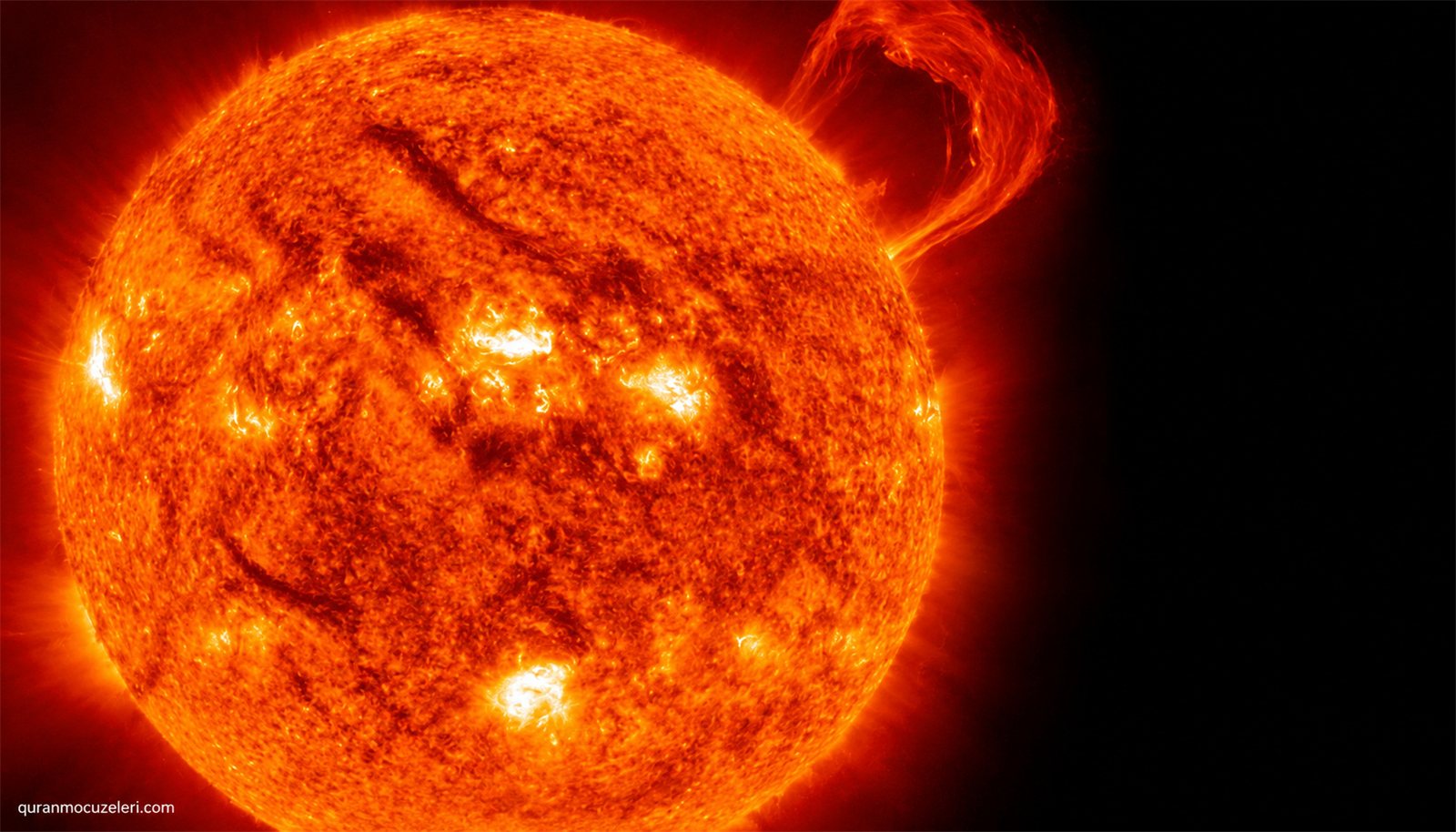
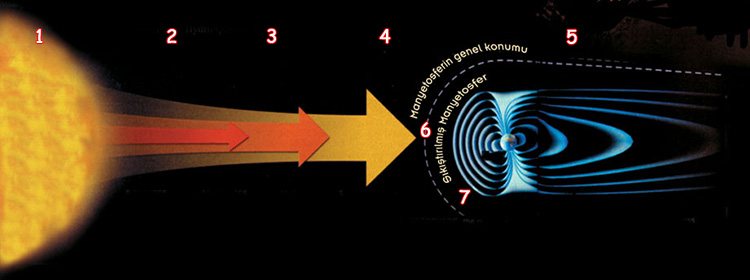
The Earth is bombarded by proton, electron and alpha particles from the Sun. These solar winds are powerful enough to separate the atmosphere from the Earth.
«Don't they see how We come to the land eroding it at its extremities?…»
The Earth is bombarded by proton, electron and alpha particles from the Sun. These solar winds are powerful enough to separate the atmosphere from the Earth. However, it will take about five times longer than the total life of the Sun at the Earth's present rate of matter loss (at most 3 kg [6.6 lbs] per second) for the atmosphere to be used up.73
That is because, thanks to the powerful magnetic field formed by the magnetosphere in the atmosphere, the Earth is to some extent protected from this powerful erosion. The loss of ions-oxygen, helium and hydrogen-dispersed over the Earth's ionosphere layer into the depths of space is of much smaller dimensions than the vast layer of air surrounding the Earth. Even so, the amount leaking into space is nevertheless of a significant size.74
Thanks to NASA spacecraft, researchers have obtained concrete evidence that energy explosions on the Sun cause oxygen and other gases to disperse into space from the outer layer of the Earth's atmosphere. Scientists first observed that the Earth experiences a loss of matter from its outer layers on September 24-25, 1998.75
However, the above verses may also be referring to the loss of land on Earth in another regard.
At the present time, the polar ice caps are melting and the water level in the oceans is rising. The increasing quantity of water is covering ever more land. As coastal areas come under water, the land surface or total amount of land is decreasing.76
The expression "eroding it from its extremities" in the above verses may well be pointing to coastal areas being covered by water.
A New York Times report on this subject reads:
The findings made towards the end of the 20th century help us to understand the wisdom of Surat ar-Ra'd 41, and Surat al-Anbiya' 44.
This loss at the extremities, as revealed by Allah, may be understood in light of another scientific fact revealed in the Qur'an. The fact that the Earth, which revolves around its own axis, has a geoid shape, is a fact that has gained acceptance in recent centuries.
Research has revealed that the equatorial diameter of the Earth expands under the effect of the force stemming from this rotation, and that it is compressed at its extremities, in other words the poles. Furthermore, since the Earth is in constant rotation this change continues to occur. Indeed, the term " nanqusu " in Surat ar-Ra'd 41, translated as "eroding," shows that this process of erosion is an ongoing one.
It is the force of gravity that has given such celestial bodies as the Earth their spherical form. However, that shape is not exactly spherical; it flattens out somewhat at the poles and thickens at the equator. According to NASA figures, the radius of the Earth is 6,378.1 km (3,963.2 miles) at the equator but only 6,356.8 km (3,949.9 miles) from pole to pole.78
This is a difference of some 0.3%.
This model of the shape of the Earth was suggested by Sir Isaac Newton in 1687. This fact, revealed in the Qur'an 1,400 years ago, is another of its scientific miracles.
The Splitting Earth
The Arabic word " sad’ " in the above verse means "cracking, splitting apart." Allah's swearing by the splitting of the Earth points to an important phenomenon, as do the other scientific miracles in the Qur'an.
«[I swear] by heaven which returns and the Earth which splits.»
The Arabic word " sad’ " in the above verse means "cracking, splitting apart." Allah's swearing by the splitting of the Earth points to an important phenomenon, as do the other scientific miracles in the Qur'an.79 Scientists first descended to the depths of the seas and oceans in order to study mineral resources in 1945-1946. One of the most important facts to emerge from that research was the fissured structure of the Earth. The rock layer on the external surface of the Earth was split by large numbers of cracks (faults), tens of thousands of kilometres long, running from north to south and east to west. Scientists also realised that there was molten magma under the sea, at depths of 100- 150 km (60-90 miles).
Due to these splits and cracks, lava flows from volcanoes on the sea bed. Due to this fissured structure, a significant amount of heat is also given off, and a large part of molten rocks forms the mountains under the oceans. If the Earth did not possess this structure, which allows large amounts of heat to escape from its crust, life on Earth would become impossible.80
There is no doubt that such information, which required such advanced technology to be discovered, being given 1,400 years ago is yet another proof that the Qur'an is the word of Allah.
The Formation of Petrol
As we know, petrol forms from the remains of plants and animals in the sea. Once these have decayed on the sea bed after millions of years, all that is left are oily substances.
«Glorify the Name of your Lord, the Most High:
He Who created and moulded; He Who determined and guided; He Who brings forth green pasture, then makes it blackened stubble.»
As we know, petrol forms from the remains of plants and animals in the sea. Once these have decayed on the sea bed after millions of years, all that is left are oily substances. These, under layers of mud and rock, then turn into petrol and gas. Movements in the Earth's crust sometimes lead to the sea petrifying and to the rocks containing petrol being buried thousands of metres deep. The petrol that forms sometimes leaks through the pores in the rock layers from several kilometres down, and rises to the surface, where it vaporises (turns into gas), leaving a mass of bitumen behind.
The three elements identified in the first four verses of Surat al- A'la parallel the formation of petroleum. It is quite likely that the term " mar’aa ," meaning "pasture or meadow," refers to the organically-based substances in the formation of petroleum. The second word of note in the verse is " ahwaa ," used to describe blackish-green, greenish-black, dark or sooty colours. This word can be thought of as describing the waste plant matter accumulated underground gradually turning black, since these words are supported by a third word, " ghuthaa' ." The word " ghuthaa' " translated as "stubble," can also mean "flood-water plants, plants brought together by waste matter being collected and dispersed around valleys, rubbish, leaves or foam." In addition to the connotation of "vomiting out" implied in the word, it may also be translated as "to flood forth vomited matter," and describes the way that the earth "vomits" forth petroleum. In fact, in the light of the formation of petroleum, the way it emerges, its foam-like appearance and its colour, one can better see with what wisdom were employed the words in the verses.
As has been discussed, the plant in the verse turning into a dark and viscous liquid bears a strong resemblance to the formation of petroleum. The description of such a formation over many years, at a time when the formation of petroleum was unknown, is without doubt another proof that the Qur'an is the revelation of Allah.
The Weight of Clouds
The weight of clouds can reach quite astonishing proportions. For example, a cumulonimbus cloud, commonly known as the thunder cloud, can contain up to 300,000 tons of water.
The weight of clouds can reach quite astonishing proportions. For example, a cumulonimbus cloud, commonly known as the thunder cloud, can contain up to 300,000 tons of water.
The fact that a mass of 300,000 tons of water can remain aloft is truly amazing. Attention is drawn to the weight of clouds in other verses of the Qur'an:
«It is He Who sends out the winds, bringing advance news of His mercy, so that when they have lifted up the heavy clouds, We dispatch them to a dead land and send down water to it, by means of which We bring forth all kinds of fruit...»
At the time when the Qur'an was revealed, of course, it was quite impossible to have any information about the weight of clouds. This information, revealed in the Qur'an, but discovered only recently, is yet another proof that the Qur'an is the word of Allah.
The Proportion of Rain
One of the items of information given in the Qur'an about rain is that it is sent down to Earth in due measure. This is mentioned in Sura Zukhruf as follows;
One of the items of information given in the Qur'an about rain is that it is sent down to Earth in due measure. This is mentioned in Sura Zukhruf as follows;
«It is He who sends down water in due measure from the sky by which We bring a dead land back to life. That is how you too will be raised (from the dead).»
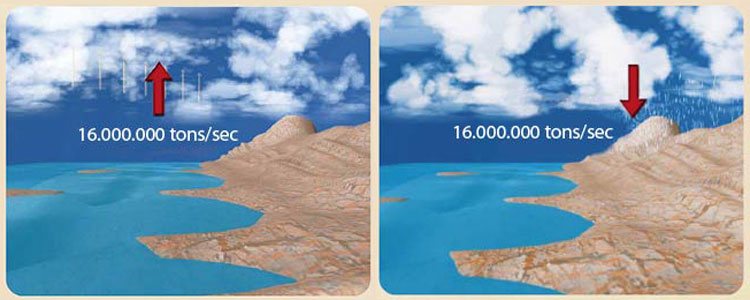
This measured quantity in rain has again been discovered by modern research. It is estimated that in one second, approximately 16 million tons of water evaporates from the Earth. This figure amounts to 513 trillion tons of water in one year. This number is equal to the amount of rain that falls on the Earth in a year. This means that water continuously circulates in a balanced cycle, in a "measure". Life on Earth depends on this water cycle. Even if people used all the available technology in the world, they would not be able to reproduce this cycle artificially.
Even a minor deviation in this equilibrium would very soon give rise to a major ecological imbalance that would bring about the end of life on Earth. Yet, this never happens, and rain keeps falling every year in exactly the same quantity just as revealed in the Qur'an.
Every year, the amount of water that evaporates and that falls back to the Earth in the form of rain is "constant": 513 trillion tons. This constant amount is declared in the Qur'an by the expression "sending down water in due measure from the sky". The constancy of this quantity is very important for the continuity of the ecological balance, and therefore, life.
The Formation of Rain
How rain forms remained a great mystery for a long time. Only after weather radar was invented was it possible to discover the stages by which rain is formed.
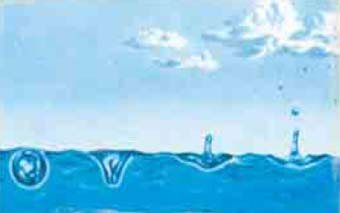
The above illustration shows the water droplets being released into the air. This is the first stage in the formation of rain. After that, the water droplets in the newly formed clouds will be suspended in the air and then condense to form rain. All of these stages are related in the Qur'an.
How rain forms remained a great mystery for a long time. Only after weather radar was invented was it possible to discover the stages by which rain is formed.
According to this, the formation of rain takes place in three stages. First, the "raw material" of rain rises up into the air with the wind. Later, clouds are formed, and finally raindrops appear.
The Qur'an's account of the formation of rain refers exactly to this process. In one verse, this formation is described in this way:
«It is God Who sends the winds which stir up clouds which He spreads about the sky however He wills. He forms them into dark clumps and you see the rain come pouring out from the middle of them. When He makes it fall on those of His slaves He wills, they rejoice»
Now, let us examine these three stages outlined in the verse more technically.
«First Stage: "It is God Who sends the winds...»
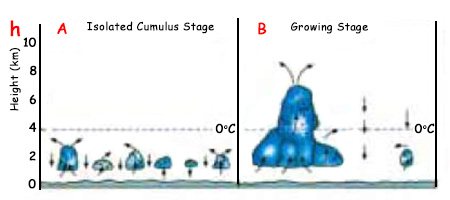
(A) Isolated small pieces of clouds (cumulus clouds) (B) When the small clouds join together, updrafts within the larger cloud increase, and so the cloud is stacked up.
Countless air bubbles formed by the foaming of the oceans continuously burst and cause water particles to be ejected towards the sky. These particles, which are rich in salt, are then carried away by winds and rise upward in the atmosphere. These particles, which are called aerosols, function as water traps, and form cloud drops by collecting around the water vapour themselves, which rises from the seas as tiny droplets.
«Second Stage: "...which stir up clouds which He spreads about the sky however He wills. He forms them into dark clumps...»
The clouds are formed from water vapour that condenses around the salt crystals or dust particles in the air. Because the water droplets in these clouds are very small (with a diameter between 0.01 and 0.02 mm), the clouds are suspended in the air, and spread across the sky. Thus, the sky is covered in clouds.
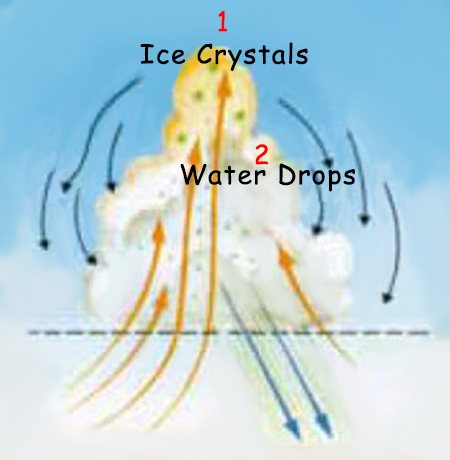
1. Ice Crystalss 2. Water Drops
«These updrafts cause the cloud body to grow vertically, so the cloud is stacked up. This vertical growth causes the cloud body to stretch into cooler regions of the atmosphere, where drops of water and hail formulate and begin to grow larger and larger. When these drops of water and hail become too heavy for the updrafts to support them, they begin to fall from the cloud as rain, hail, etc. This scientific fact was announced in verse 43 of Sura Nur fourteen centuries ago by God in this way: "...then (He) makes them into a stack, and then you see the rain come out of …»
«Third Stage: "...and you see the rain come pouring our from the middle of them»
The water particles that surround salt crystals and dust particles thicken and form raindrops, so, drops that become heavier than the air leave the clouds and start to fall to the ground as rain.
As we have seen, every stage in the formation of rain is related in the verses of the Qur'an. Furthermore, these stages are explained in exactly the right sequence. Just as with many other natural phenomena on the Earth, God gives the most correct explanation of this phenomenon as well, and made it known to people in the Qur'an centuries before it was discovered.
In another verse, the following information is given about the formation of rain:
«Have you not seen how God drives along the clouds, then joins them together, then makes them into a stack, and then you see the rain come out of it? And He sends down from the sky mountain masses (of clouds) with cold hail in them, striking with it anyone He wills and averting it from anyone He wills. The brightness of His lightning almost blinds the sight.»
Scientists studying cloud types came across surprising results regarding the formation of rain clouds. Rain clouds are formed and shaped according to definite systems and stages. The formation stages of cumulonimbus, one kind of rain cloud, are these:
Small clouds (cumulus clouds) are carried along and joined together by the wind, that is, as the verse says: "ÉGod drives along the clouds, then joins them together…"
Stage, Being driven along: Clouds are carried along, that is, they are driven along, by the wind.
Stage, Joining: Then, small clouds (cumulus clouds) driven along by the wind join together, forming a larger cloud.82
Stage, Stacking: When the small clouds join together, updrafts within the larger cloud increase. The updrafts near the centre of the cloud are stronger than those near the edges. These updrafts cause the cloud body to grow vertically, so the cloud is stacked up. This vertical growth causes the cloud body to stretch into cooler regions of the atmosphere, where drops of water and hail formulate and begin to grow larger and larger. When these drops of water and hail become too heavy for the updrafts to support them, they begin to fall from the cloud as rain, hail, etc.83
We must remember that meteorologists have only recently come to know these details of cloud formation, structure and function, by using advanced equipment like planes, satellites, computers etc. It is evident that God has given us a piece of information that could not have been known 1,400 years ago.
The Quivering and Swelling of the Earth
The Arabic word for "quivers" is " ihtazzat ," meaning "to set in motion, come alive, quiver, move, stir; the movement and stretching of a plant." The word " rabat ," translated as "swells," bears the meanings "to increase, grow…
«And you see the earth dead and barren. Then, when We send down water onto it, it quivers and swells and sprouts with luxuriant plants of every kind.»
The Arabic word for "quivers" is " ihtazzat ," meaning "to set in motion, come alive, quiver, move, stir; the movement and stretching of a plant." The word " rabat ," translated as "swells," bears the meanings "to increase, grow in number, swell, grow, develop, rise (of a plant), provision, fill with air." These words describe in the most appropriate manner the changes that occur in the molecular structure of soil during rain.
The motion described in the verse is different from the movement of Earth's crust, such as when a portion of it moves to produce an earthquake, for it is only the soil particles that are moving. These particles are composed of layers, each of which is on top of the other. When water penetrates the layers, it causes the swelling of mud particles. The stages referred to in the verse can be scientifically explained as follows:
1. Quivering of the soil: The electrostatic charge on the particle sur-
face that appears after the water falls on the soil in sufficient amount would cause its instability and quivering movements. This movement is stabilized only after this charge has been neutralized with an opposing one. The soil particle's moving and quivering is also due to its collision with water particles. Since the water particles move in no specific direction, the soil particles move as they are struck from all sides. Robert Brown, a Scottish botanist, discovered in 1827 that when raindrops fall on the soil, they cause a kind of shaking and vibration in the soil molecules. He described this movement of microscopic particles, which today is known as the "Brownian motion."84
2. Swelling of the soil: When it rains, those raindrops hitting the soil
cause its particles to swell and increase in volume. This is because when there is abundant water, the space between soil particles, which allows water particles and dissolved ions to enter, increases. When water and the nourishing elements dissolved in it diffuse between the layers, the size of the soil particles increases. Consequently, these particles serve as water deposits that bring the soil to life. It is due to Allah's infinite grace upon humanity that this water is stored in this manner without seeping downward due to the action of gravity. If the soil could not hold water and these mineral deposits could not be laid down in the soil, the water would soak into Earth's deepest parts and, because of its resulting absence, all plants would soon die. However, our Lord has created the soil in such a way that various products can emerge from it.
3. Sprouting of the earth: When there is enough water in the soil, the
seeds become active and absorb simple nutritious material. Growing plants meet their water requirements for 2 to 3 months from these deposits.
The above verse describes, in three stages, what happens when rain falls onto dry ground: the soil particles quiver, and the soil swells and then brings forth various products. These stages, which the Qur'an revealed 1,400 years ago, are strikingly parallel to the scientific descriptions. Another verse reveals this about plants:
«Asign for them is the dead land that We bring to life and from which We bring forth grain, of which they eat.»
As well as bringing water, an essential requirement for living things, to the earth, the rain also has a fertilising property. Drops of rain which evaporate from the sea and reach the clouds contain certain substances which "revitalise" dead soil. These raindrops with such "revitalising" properties are called "surface tension droplets. " These form from the top layer of the surface of the sea, called the microlayer by biologists; in this surface layer, less than one-tenth of a millimetre thick, are found large quantities of organic waste formed from the decomposition of microscopic algae and zooplanktons. Some of these wastes collect and absorb elements such as phosphorus, magnesium and potassium, which are rarely found in sea water, as well as heavy metals such as copper, zinc, cobalt and lead. Seeds and plants on the surface of the Earth receive large quantities of the mineral salts and elements they need to grow from these raindrops. The Qur'an refers to this in these terms:
«And We sent down blessed water from the sky a nd made gardens grow by it and grain for harvesting.»
These salts which descend with the rain are examples in miniature of fertilisers traditionally used to enhance productivity (calcium, magnesium, potassium etc.). Heavy metals of the kind found in aerosols create elements which increase productivity during growth and production of plants. In short, rain is an important fertiliser. With the fertiliser provided by rain alone, within a hundred years, a soil of poor quality can obtain all the elements necessary for plants. Forests also grow and are nourished with help from these chemicals which originate from the sea.
In this way, every year some 150 million tons of particles of fertiliser fall to earth. Were it not for this fertilising function, there would have been far fewer plants on the Earth and the balance of life would have been disturbed. The information about the revitalisation of plants in the verse is just one of the countless miraculous properties of the Qur'an.
The Formation of Hail, Thunder and Lightning
The above verse refers to hail and lightning. When the formation of hail and lightning are examined, it can be seen that an important meteorological truth is being indicated in this verse.
«… He sends down mountains from the sky with hail inside them, striking with it anyone He wills and averting it from anyone He wills. The brightness of His lightning almost blinds the sight.»
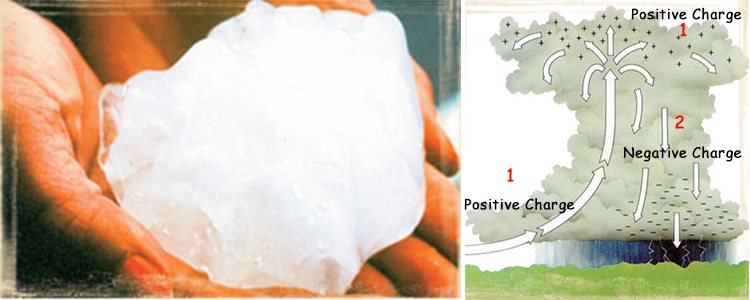
The above verse refers to hail and lightning. When the formation of hail and lightning are examined, it can be seen that an important meteorological truth is being indicated in this verse. About the formation of lightning and hail, the book Meteorology Today says that a cloud becomes electrified as hail falls through a region in the cloud of supercooled droplets and ice crystals. Liquid droplets freeze and release latent heat as they collide with a hailstone. This keeps the surface of the hailstone warmer than that of the surrounding ice crystals. An important phenomenon occurs when the hailstone comes in contact with an ice crystal: Electrons flow from the colder object toward the warmer one. In this way, the hailstone becomes negatively charged. This effect also occurs when supercooled droplets come in contact with a hailstone and small pieces of positively charged ice break off. These particles, which are lighter and positively charged, are carried to the upper part of the cloud by currents of air. The hail has a negative charge now, and falls towards the bottom of the cloud, thus the lower part of the cloud becomes negatively charged. These negative charges are then discharged as lightning. It may be concluded from this that hail is the main factor in the formation of lightning.85
In the following verse, however, attention is drawn to the link between rain clouds and lightning, and to the order of formation, information that parallels that discovered by science:
«Or [their likeness is] that of a storm-cloud in the sky, full of darkness, thunder and lightning. They put their fingers in their ears against the thunderclaps, fearful of death…»
Rain clouds are tremendous masses covering 20 to 260 square metres (10 to 100 square miles) and reaching great vertical heights of 9,000 to 12,000 metres (30,000 to 40,000 ft.). Due to these extraordinary dimensions, the lower part of these clouds are dark. It is impossible for the Sun's rays to pass through them, because of the large quantities of water and ice particles they contain. Very little solar energy therefore reaches the Earth through the clouds, which is why the clouds appear dark to someone looking up at them.86
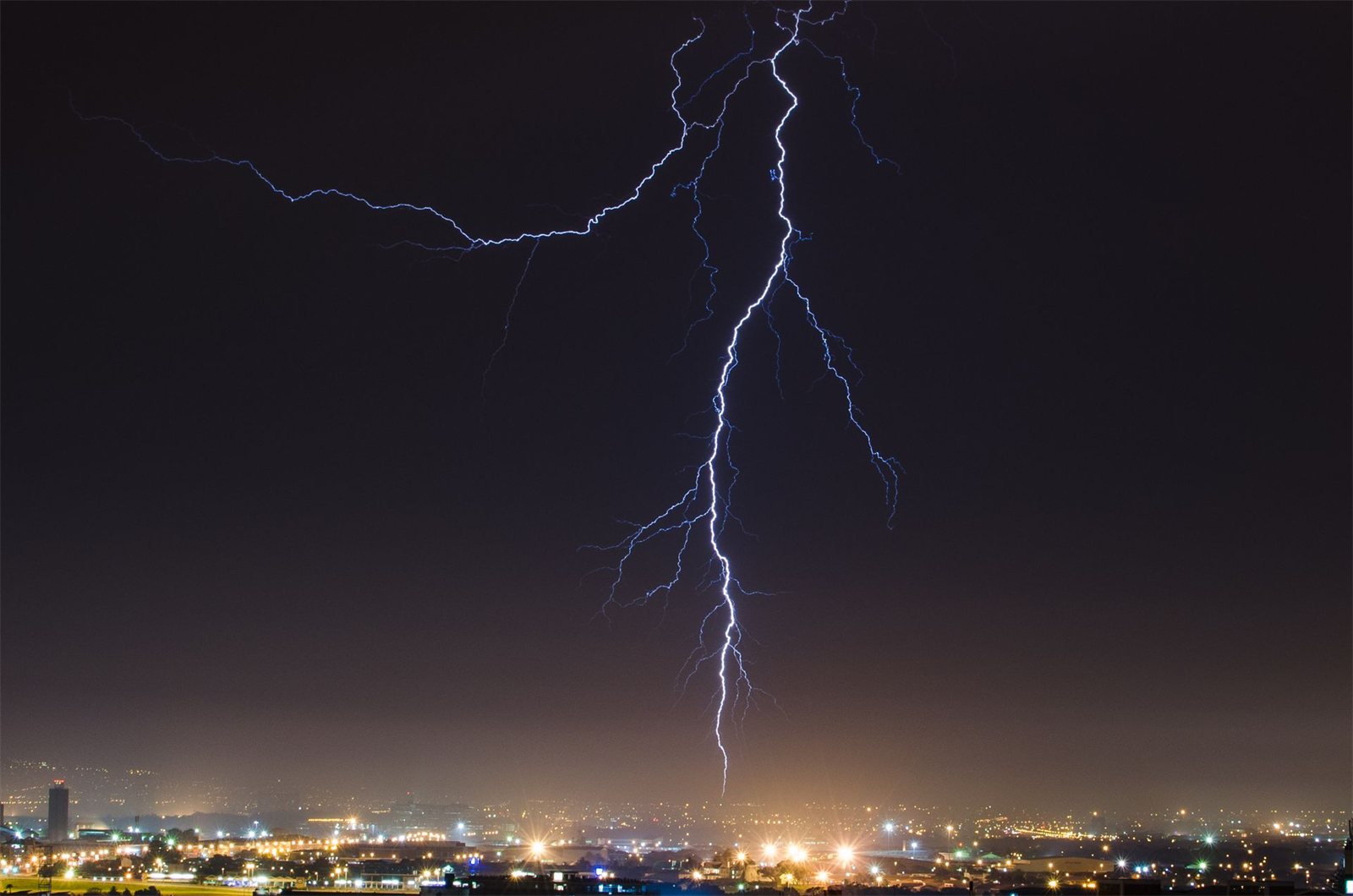
The stages of the formation of thunder and lightning after that darkness, mentioned in the verse, are as follows: An electrical charge forms inside the rain cloud. This comes about as a result of such processes as freezing, the division of raindrops and charge formation during contact. The accumulation of such electrical charges, when the air between becomes unable to insulate them, leads to a great spark, a discharge between the positive and negative fields. The voltage between two oppositely charged areas can reach 1 billion volts. The spark can also form within the cloud, can cross between two clouds, from a positively charged area to a negative one, or be discharged from the cloud to the ground. These sparks form dazzling lightning strikes. This sudden increase in the electrical charge along the line of lightning causes intense heat (10,000 degrees Celsius [18,030 degrees Fahrenheit]). As a result, there is a sudden expansion of the air, which in turn causes the loud noise associated with thunder.87
As has been discussed, dark layers, followed by the electrically charged sparks known as lightning, and then the loud noise called thunder, form within a rain cloud. Everything modern science has established about clouds, and has to say about the causes of thunder and lightning, is in complete accord with the descriptions in the Qur'an.
The fertilising winds
Surat al-Hijr says that the winds were sent as “fertilisers” and that water was then sent down from the sky. Modern meteorology has shown that winds play exactly this role in the formation of rain.
switch between the two modes
0.01 mm: diameter of “aerosol” particles
1946: first experiments in seeding clouds
2 roles: they fertilise both clouds and plants
In one verse of the Qur'an, the "fecundating" characteristic of the winds, and the formation of rain as a result are mentioned.
«And We send the fecundating winds, then cause water to descend from the sky, therewith providing you with water in abundance.»
In this verse, it is pointed out that the first stage in the formation of rain is wind. Until the beginning of the 20th century, the only relationship between the wind and the rain that was known, was that the wind drove the clouds. However, modern meteorological findings have demonstrated the "fecundating" role of the wind in the formation of rain.
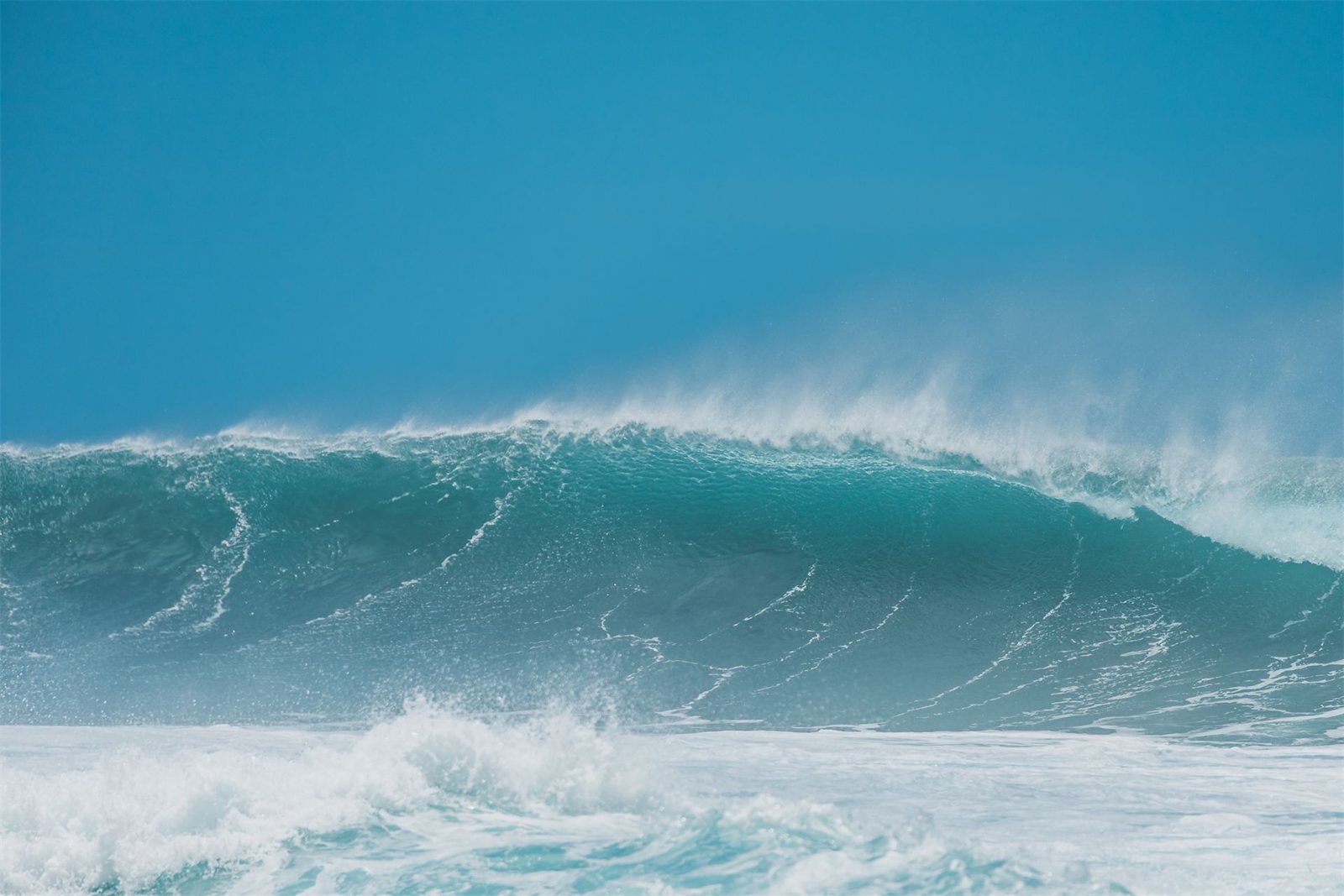
The picture above shows the stages in the formation of a wave. Waves are formed by the wind blowing above the surface of the water. With the wind, water particles start to move in a circular motion. This movement soon forms waves, one after the other, and bubbles formed by the waves spread in the air. This is the first stage in the formation of rain. This process is declared in the verse as "We send the fecundating winds and then cause water to descend from the sky."
This fecundating function of the wind works in the following way:
On the surface of oceans and seas, countless air bubbles form because of the water's foaming action. The moment these bubbles burst, thousands of tiny particles, with a diameter of just one hundredth of a millimeter, are thrown up into the air. These particles, known as "aerosols", mix with dust carried from the land by the wind, and are carried to the upper layers of the atmosphere. These particles carried to higher altitudes by winds come into contact with water vapour up there. Water vapour condenses around these particles and turns into water droplets. These water droplets first come together and form clouds, and then fall to the Earth in the form of rain.
As seen, winds "fecundate" the water vapour floating in the air with the particles they carry from the sea, and eventually help the formation of rain clouds.
If winds did not possess this property, water droplets in the upper atmosphere would never form, and there would be no such thing as rain.
The most important point here is that this critical role of the wind in the formation of rain was stated centuries ago in a verse of the Qur'an, at a time when people knew very little about natural phenomena…
The Stages of Wind Formation
Wind is a movement of air which forms between two different temperature centres. Due to the different pressures caused by different temperatures in the atmosphere, air constantly flows from areas of high pressure to areas of low…
«… and [in His] directing of the winds, there are signs for people who use their intellect.»
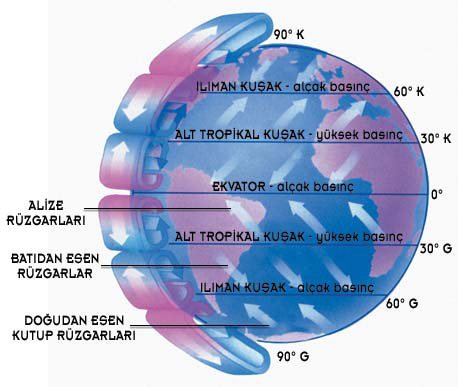
Wind is a movement of air which forms between two different temperature centres. Due to the different pressures caused by different temperatures in the atmosphere, air constantly flows from areas of high pressure to areas of low pressure. If differences between pressure centres, in other words, temperatures in the atmosphere, are large, the flow of air, in other words, the wind, is very strong, so strong in fact that tornadoes which can inflict terrible damage can be formed.
What is astonishing here is that, despite there being belts of very different temperatures and pressures, such as the equator and the poles, thanks to the order in Allah's creation, our Earth is not exposed to disastrously fierce winds. Were the force of the winds that would otherwise blow between the poles and the equator not tempered, the Earth would become a dead planet constantly buffeted by tornadoes.
In the Arabic expression " tasreefi al-riyaah ," in the above verse, the word " tasreef " means "turning over many times, directing, shaping something, managing, distributing." The choice of this word for the wind fully describes the way it blows in an ordered manner. It is also a clear expression of the fact that the wind does not blow by chance, of its own accord. It is Allah Who directs the winds in such a way as to make human life possible.
Seas that do not mix
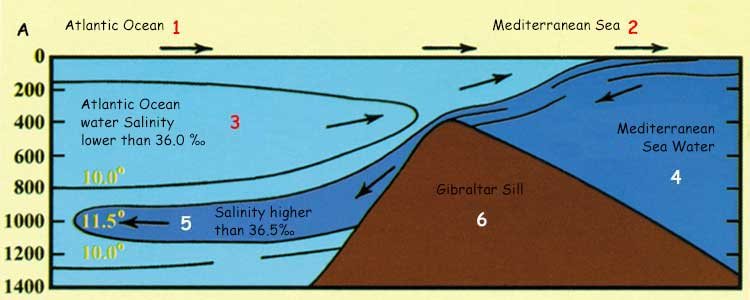
Surat ar-Rahman speaks of two seas that meet yet do not mix because of a barrier between them. Oceanographers discovered this fact only in the recent past.
try stirring the water
> 36.5 ‰: salinity of Mediterranean water
< 36.0 ‰: salinity of Atlantic water
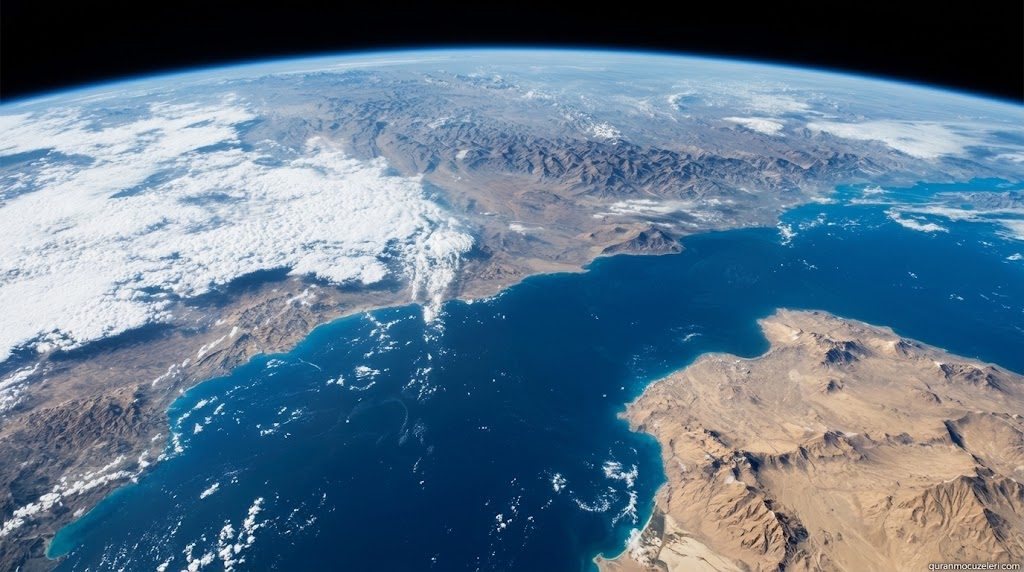
Gibraltar: the strait where the two seas meet
One of the properties of seas that has only recently been discovered is related in a verse of the Qur'an as follows:
«He has let loose the two seas, converging together, with a barrier between them they do not break through.»
A. Depths (metres) 1. Atlantic Ocean 2. Mediterranean Sea 3. Atlantic Ocean Water Salinity lower than 0.36 % 4. Mediterranean Sea Water 5. Salinity higher than 0.365 % 6. Gibraltar Sill There are large waves, strong currents, and tides in the Mediterranean Sea and the Atlantic Ocean. Mediterranean Sea water enters the Atlantic by Gibraltar. But their temperature, salinity, and densities do not change, because of the barrier that separates them.
This property of the seas, that they come together yet do not mingle with one another at all, has only very recently been discovered by oceanographers. Because of the physical force called "surface tension", the waters of neighboring seas do not mix. Caused by the difference in the density of their waters, surface tension prevents them from mingling with one another, just as if a thin wall were between them.88
The interesting side to this is that during a period when people had no knowledge of physics, surface tension, or oceanography; this was revealed in the Qur'an.
A satellite photograph of Gibraltar
Darkness and internal waves in the deep sea
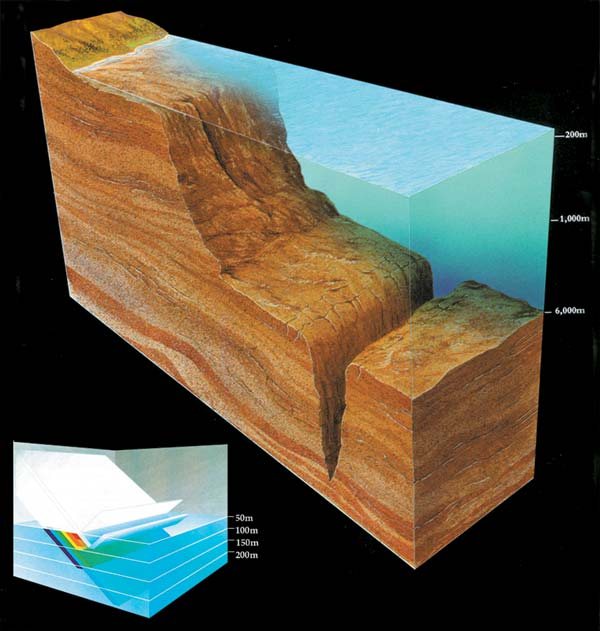
Surat an-Nur describes “darknesses, one above another” in a vast deep sea, with wave upon wave. Today we know there is almost no light below 200 metres, and that invisible internal waves move within the ocean.
change the depth with the slider
3–30%: of sunlight reflected at the sea surface
200 m: almost no light remains
1000 m: total darkness
«Or (the unbelievers' state) are like the darkness of a fathomless sea which is covered by waves above which are waves above which are clouds, layers of darkness, one upon the other. If he puts out his hand, he can scarcely see it. Those God gives no light to, they have no light.»
The general environment in deep seas is described in the book named Oceans:
The darkness in deep seas and oceans is found around a depth of 200 meters and below. At this depth, there is almost no light. Below a depth of 1000 meters there is no light at all.89
Measurements made with today's technology have revealed that between 3 and 30 percent of the sunlight is reflected at the surface of the sea. Then, almost all of the seven colours of the light spectrum are absorbed, one after another, in the first 200 meters, except for blue light (picture at left). Below a depth of 1,000 meters, there is no light at all. (above picture). This scientific fact was pointed out in the verse 40 of Sura Nur in the Qur'an 1,400 years ago.
Today, we know about the general structure of the sea, the characteristics of the living things in it, its salinity, as well as the amount of water it contains, its surface area and depth. Submarines and special equipment, developed with modern technology, enable scientists to obtain this information.
Human beings are not able to dive more than 40 meters down without the aid of special equipment. They cannot survive unaided in the deep, dark parts of the oceans, such as at a depth of 200 meters. For these reasons, scientists have only recently been able to discover these detailed pieces of information about seas. However, the statement of "darkness in a deep sea" was used in Sura Nur 1,400 years ago. It is certainly one of the miracles of the Qur'an that such information was given at a time where no equipment to enable man to dive into the depths of the oceans was available.
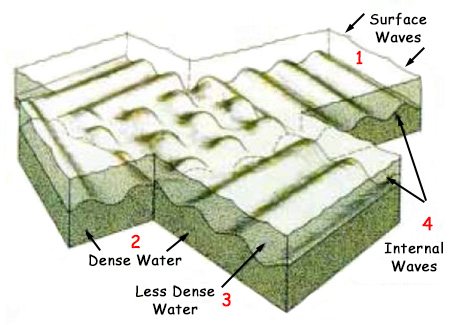
1. Surface Waves 2. Dense Water 3. Less Dense Water 4. Internal Waves The picture to the left represents internal waves at interface between two layers of water of different densities. The lower layer is denser then the upper one. This scientific fact, declared in verse 40 of Sura Nur of the Qur'an 14 centuries ago, has been discovered by today's scientists only very recently.
«In addition, the statement in verse 40 of Sura Nur "...like the darkness of a fathomless sea which is covered by waves above which are waves above which are clouds..." draws our attention to another miracle of the Qur'an.»
Scientists have recently discovered that there are internal waves, which "occur on density interfaces between layers of different densities." These internal waves cover the deep waters of seas and oceans because deep water has a higher density than the water above it. Internal waves act like surface waves. They can break, just like surface waves. Internal waves cannot be seen by the human eye, but they can be detected by studying temperature or salinity changes at a given location.90
The statements in the Qur'an run absolutely parallel to the above explanation. Without research, one can only see the waves on the surface of the sea. It is impossible for one to know about the internal waves beneath the sea. Yet, in Sura Nur, God draws our attention to another type of wave that occurs in the depths of the oceans. Certainly, this fact, which scientists has discovered very recently, shows once again that the Qur'an is the word of God.
Fossilization and Iron Content
These verses refer to the petrification of dead bodies and how these corpses, over time, turned into iron.
«They say, 'What! When we are bones and crumbled dust, will we then be raised up as a new Creation!' Say: 'It would not matter if you were rock or iron or indeed any created thing that you think is harder still!' They will say, 'Who will bring us back again?' Say: 'He Who brought you into being in the first place'...»
These verses refer to the petrification of dead bodies and how these corpses, over time, turned into iron. Living tissue is not preserved over millions of years – which is why it is only possible to clearly see creatures of the past today once they have been fossilized. After they die, living things can be preserved for millennia by the fossilization process, by their bodies literally turning into stone under the ground. The word "fossil" refers to "the preservation of a living thing by petrification," by its turning into stone.
A petrified fossil sea shell dating back millions of years with iron remains that have formed over it
Iron is preserved undamaged in the body as the body becomes fossilized. Human beings need to consume an average of 10-15 milligrams of iron a day in order to be healthy. Any excess iron consumed is stored in the liver. In addition, the protein transferred in blood plasma also carries a certain amount of iron.91 The reference in the verse to the presence of iron in the remains of the human body is exceedingly wise from that point of view.
Research has also shown the presence of "pyrite," (FeS2) a compound of iron and sulfur, in fossils.92 The iron sulfide forms very easily during the degradation of organic substances. It is therefore generally found in fossil shells and is capable of damaging the fossils since it can react with oxygen and water. The words "crumbled dust" in the verse may be a reference to "pyrite degradation," which leads to the fragmentation and collapse of a fossil as pyrite reacts with water and oxygen.93
Another fact confirmed by recent findings is that matter constantly seeks the most stable state.
This is the very nature of matter. Therefore, given sufficient time, all matter will eventually turn into iron. Iron is the most stable state of nuclear matter. In fact, cosmologists predict a stage in which everything we know will turn into iron as a result of nuclear fusion and nuclear fission reactions.94 In his book In Search of Schrödinger's Cat: Quantum Physics And Reality, the astrophysicist John Gribbon describes how iron is the most desirable state of matter and how all matter in the universe wants to turn into iron.95
The revelation in the Qur’an about human remains petrifying and fossilizing leading to an iron-dominant state, is a fact that has now been scientifically confirmed. In the same way that no archaeological, paleontological, geological or astronomical research was possible at the time the Qur'an was revealed, neither was it possible to identify the elements using an electron microscope. Thus, the facts revealed in the verse in Surat al-Isra’ once more confirm that the Qur'an is a divine text.
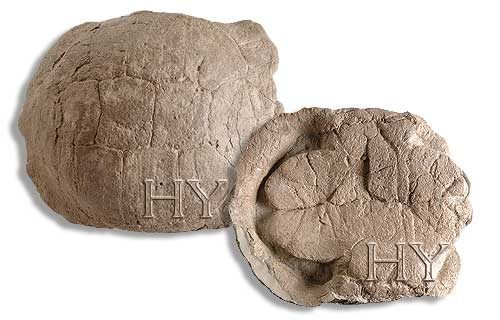
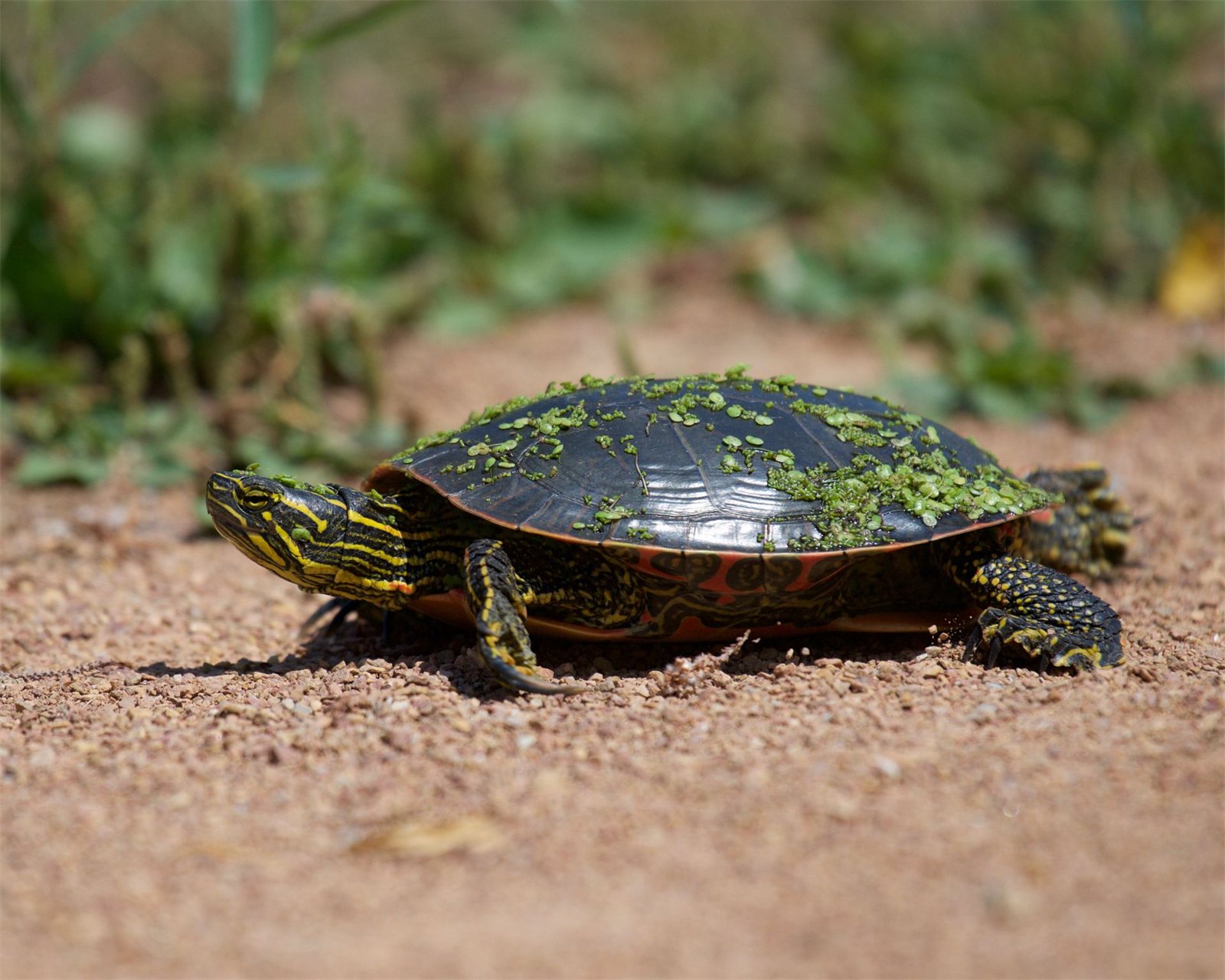
A 125-million-year-old fossil tortoise (left) It is identical to the present-day turtle (right).
Radio Receivers on Mountains
There is a strong possibility that the description of mountains "echoing" in the above verse may refer to the workings of a modern radio.
«We gave David great favor from Us:
"O mountains and birds! Echo with him in his praise!" And We made iron malleable for him:»
There is a strong possibility that the description of mountains "echoing" in the above verse may refer to the workings of a modern radio. (Allah knows the truth.) The basic principles on which radios operate may be summarized as follows:
A radio system consists of a transmitter and a receiver. The transmitter takes the message to be sent, encodes it in what is known as a "sine wave" and transmits it in the form of waves through the air. The receiver takes in the radio waves and deciphers the message sent on the sine wave. In this way, the message is received in exactly the same form as it was sent. The word "awwibee," translated as "echo" in the above verse and meaning "sound being repeated or returned", may very well be a reference to the transmission of these radio waves. (Allah knows the truth.)
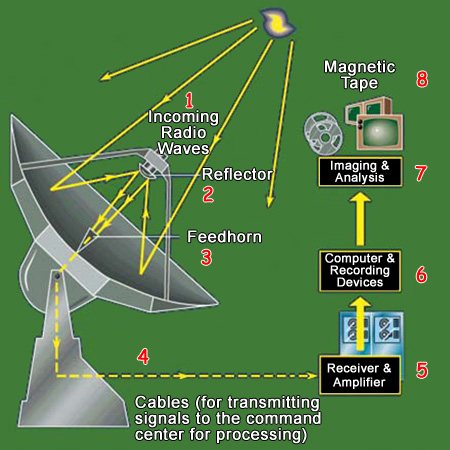
1. Incoming Radio Waves 2. Reflector 3. Feedhorn 4. Cables (for transmitting signals to the command center for processing) 5. Receiver and Amplifier 6. Computer and Recording Devices 7. Imaging and Analysis System 8. Magnetic Tape
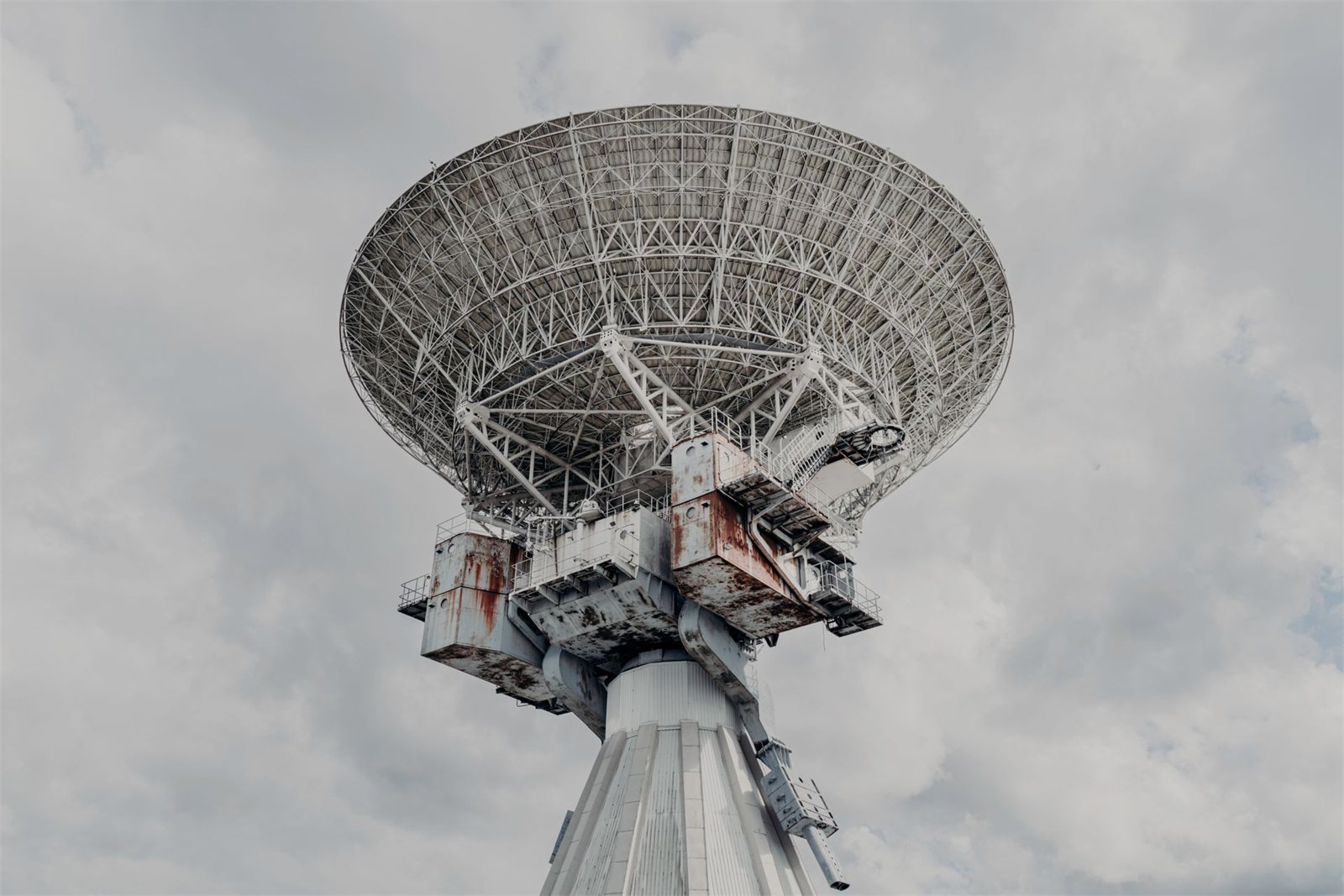
Sounds are emitted in the form of sound waves by way of an antenna. This is in order that the receiver can take in the data which has been sent via an antenna linked to the receiver. The purpose behind using antennae is the transmission into space of the waves emitted by the radio transmitter. The receiving antenna is intended to collect as many radio waves and messages as possible. This is why NASA uses giant antennae dishes 70 meters across for its satellites millions of kilometers away in space.
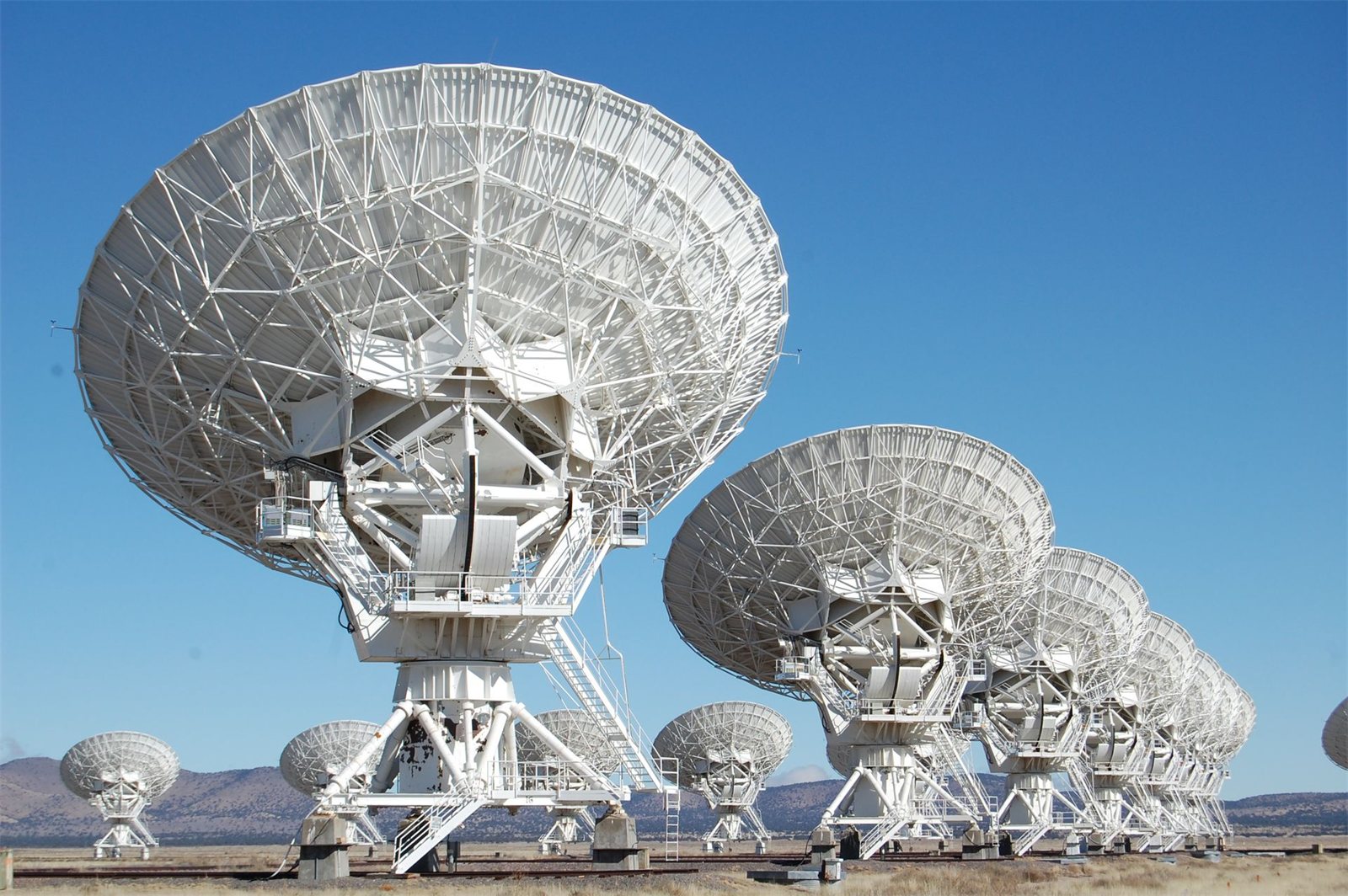
There are also radio telescopes which can use radio waves to form images. Since radio waves are very long, a radio telescope has to be much larger in order to collect them as clear images. In order to obtain sharper and better images, astronomers use a connected series of smaller telescopes or receptors. These telescopes act collectively as one very large device – almost like a team, each with its own role. In their physical appearance, these antennae series resemble mountain systems.
In addition, "repeaters" are employed to permit radio communications over great distances. These devices repeat and strengthen weak signals and enable them to be transmitted over considerable distances. Such devices are generally sited on tall buildings or preferably on the tops of mountains, in order to have the greatest effect. The use of the word "awwibee," translated as "echo" in the above verse, is exceedingly wise. The statement of, "O mountains and birds! Echo with him in his praise!'" in verse 10 of Surah Saba' may be a description of that technology. (Allah knows the truth.)
Each of the antennae in the picture weighs 212 tons, and are as high as a 10-storey building and measure at least 25 meters across. A radio telescope on Peach Mountain, in Dexter, Michigan
The Expanding Earth
The Arabic term“madda al-arda” translated “as stretched out” in the above verse, means “to be covered, spread out, stretched, pulled out, expanded or opened.” The use of this word in the context of the earth in referring to the…
«It is He Who stretched out the earth and placed firmly embedded mountains and rivers in it and made two types of every kind of fruit. He covers over day with night. There are signs in that for people who reflect.»
The Arabic term“madda al-arda” translated “as stretched out” in the above verse, means “to be covered, spread out, stretched, pulled out, expanded or opened.” The use of this word in the context of the earth in referring to the formation of mountains and rivers is exceedingly wise, because looking at the scientific explanation of the formation of the earth, it does indeed appear that mountains and rivers formed through the stretching and expansion of the earth.
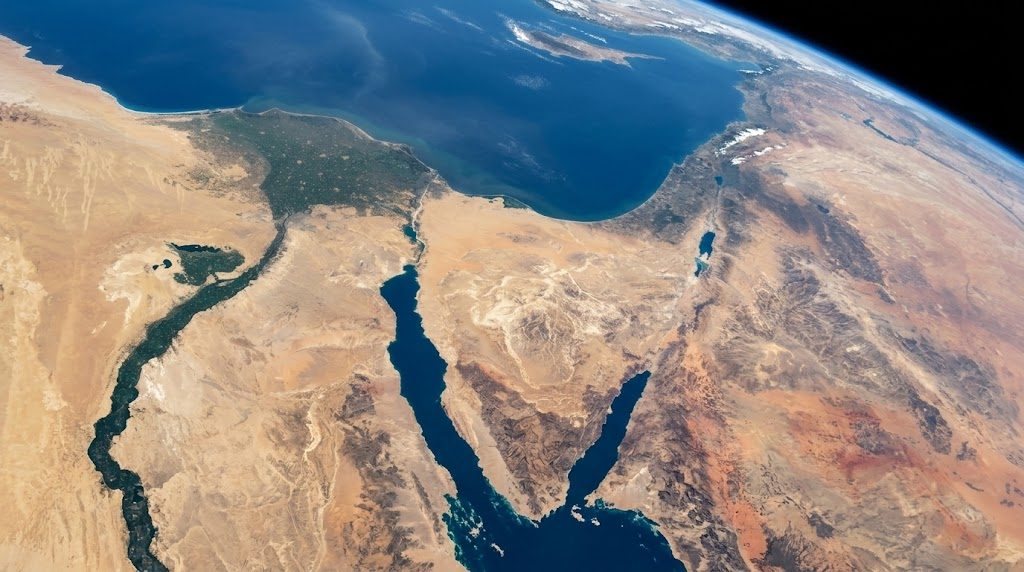
This photograph taken by NASA from space shows the Gulf of Aqaba and the Suez Canal, to the east of the Sinai Peninsula. The Sinai Peninsula, the Dead Sea and the River Jordan constitute the northern part of the Great Rift Valley.
Present day science says that the earth had a very different appearance in the very earliest times compared to what it is now. In his book Die Entstehung der Kontinente und Ozeane (The Origin of the Continents and Oceans) printed in 1915, the famous German scientist Alfred Lothar Wegener proposed that all the continents had originally been one single land mass. This great land mass later came to be known by the Greek name Pangaea, meaning “all continents.96 According to Alfred Wegener's theory of “continental drift,” put forward in 1912, the continents at the two ends of the Atlantic Ocean are still moving away from one another. This theory assumed its latest, present-day state with the development of the scientific theory known as plate tectonics. Continents do not move away from one another by sliding over the ocean floor, rather the ocean floor and the continents drift together over a layer of liquid magma under great heat and pressure and known as the “astenosphere” or “upper crust.” Therefore, both the land continents on earth visible from the outside and also the crust under the sea are both in motion together.97
Because the plates that bear the continents move in a manner described as contraction and expansion, or stretching, the continents are today moving away from one another at a rate of approximately three centimeters per year.98 The most evident expansion taking place on the sea bed is that between Arabia and Africa, where the continents are moving away from one another three or four times faster. When the expansion takes place on the continent, rather than on the sea bed, the result is constantly widening valleys such as the Great Rift Valley in the East Africa-Arabia regions.
A reconstruction from the time when there was only one large continent - Pangaea- about 300 million years ago.
The Great Rift Valley is a geographical and geological formation stretching some 6000 kilometers, from Sudan in North Africa to Mozambique in the east. The valley ranges from 30-100 kilometers in width and is several thousand kilometers deep.99 This deep valley brought such formations as Mount Kilimanjaro and Mount Kenya into being as Africa and the Arabian Peninsula moved away from one another over a process lasting millions of years. The eastern part of valley consists of the River Jordan, the Dead Sea and the Gulf of Aqaba. It then extends southward along the Red Sea and various lakes in Kenya. Most of these lakes are very deep and below sea-level.100
The book The Expanding Earth describes how it is not only mountains, but also certain river beds that formed due to the “expansion” of the earth:
In all cases the greatest stress occurred at the location of the earth's major rivers. This development suggests that the major riverbeds came into existence as a result of expansion rather than random erosion. Since the continents were fixed on an expanding surface, it may be logically deduced that expansion caused the land masses to stretch and, at the points of greatest tension, to break, thus forming the rivers.101
In statements regarding the continent of North America, the Utah Geological Research Center says:
The ranges and basins have been forming for the past 10 to 20 million years in response to east-west stretching of the earth's crust. Stretching creates tension that is released by slow continuous movement or sudden movement along a fault (a break in the earth's crust), which causes earthquakes. During an earthquake, the mountains rise while the valleys drop along the faults. The stretching continues today.102
Facts such as the expansion of the earth can only be established by comprehensive research and common data from various contemporary branches of science. For example, photographs taken by satellite, the product of 20th century technology, have confirmed the view that the continents were once complementary to one another. Highly accurate measurements have revealed that the expansion in the earth’s crust is continuing at a slow but specific rate. The presence of such special information in the Qur’an, at a time when nobody could determine anything about the continents and, what is more, about formations that took millions of years to develop, once again shows that it is the word of Allah. The way that the Qur’an, revealed 1,400 years ago, contains such profound information about the formation of the earth, is one of its scientific miracles.
The Ozone Layer at the Poles as The Sun Rises
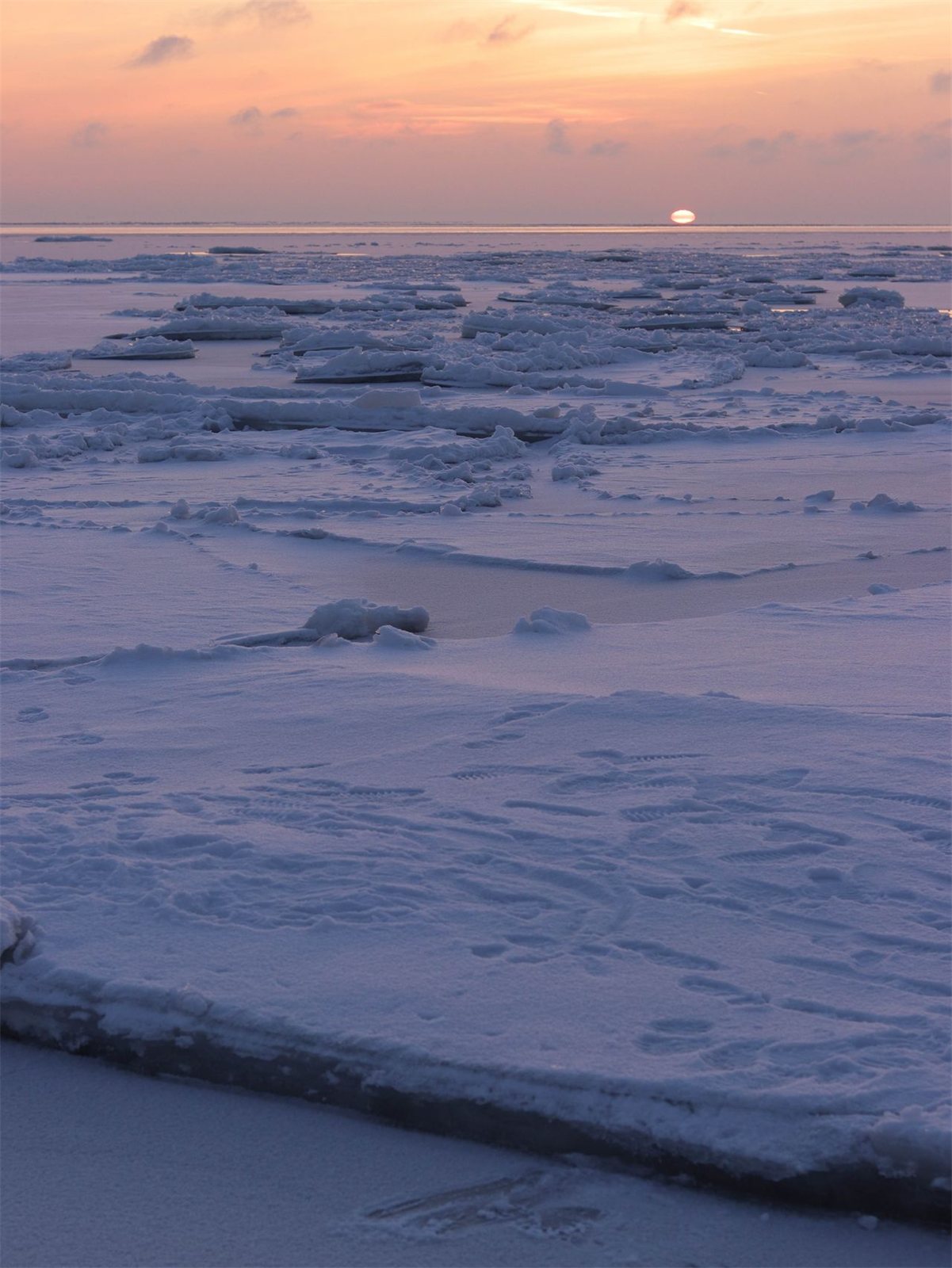
The Arabic word "sitran" in this verse means "cover, protection, veil" while "lam naj’aal lahum min dooniha sitran"describes an environment devoid of any shelter or protection against the Sun.
«Until he reached the rising of the Sun and found it rising on a people to whom We had not given any shelter from it.»
The Arabic word "sitran" in this verse means "cover, protection, veil" while "lam naj’aal lahum min dooniha sitran"describes an environment devoid of any shelter or protection against the Sun. In the light of present-day knowledge, this is suggestive of the ozone layer that protects living things against harmful solar rays.
The area where the ozone layer offers the least protection against solar radiation is at the poles of our planet—North and South.103 Scientific research has established a severe thinning of the ozone layer at the North Pole at the moment the Sun rises104 and this scientific discovery has been described as Sunrise Ozone Destruction (SOD).105
During their research, American scientists determined a rapid decrease in ozone concentration at the moment of sunrise–when there was no sign of any before.106 This phenomenon is particularly encountered in the North Pole (Arctic) region. Here, there is a massive loss of ozone for a few hours immediately after sunrise.107
The Arabic word "matli’a" in this verse, meaning the "place of birth, time of birth" of the Sun, may well be a reference to this scientific discovery about the ozone layer. (Allah knows the truth.) The fact that this information, obtained with the 20th century high technology, also appears in such a compatible form in the Qur'an, is yet more proof that the Qur'an is the revelation of our Lord, the One and Only Lord of science and technology.
It is He Who splits the sky at dawn, and appoints the night as a time of stillness and the sun and moon as a means of reckoning. That is what the Almighty, the All-Knowing has ordained.